
Hydrostatic Testing in Houston, TX
Houston homes sit on slab foundations, and the sewer lines beneath them can leak for months or years without a single visible sign. Repipe Solutions Inc. gives you a definitive answer in about an hour: a licensed plumber, a documented test, and a written report with a map of your drain lines. No guesswork, no pressure, and upfront pricing before we start.
Same-Day Service | Upfront Pricing | 24 Months at 0% Financing
What Is Hydrostatic Testing?
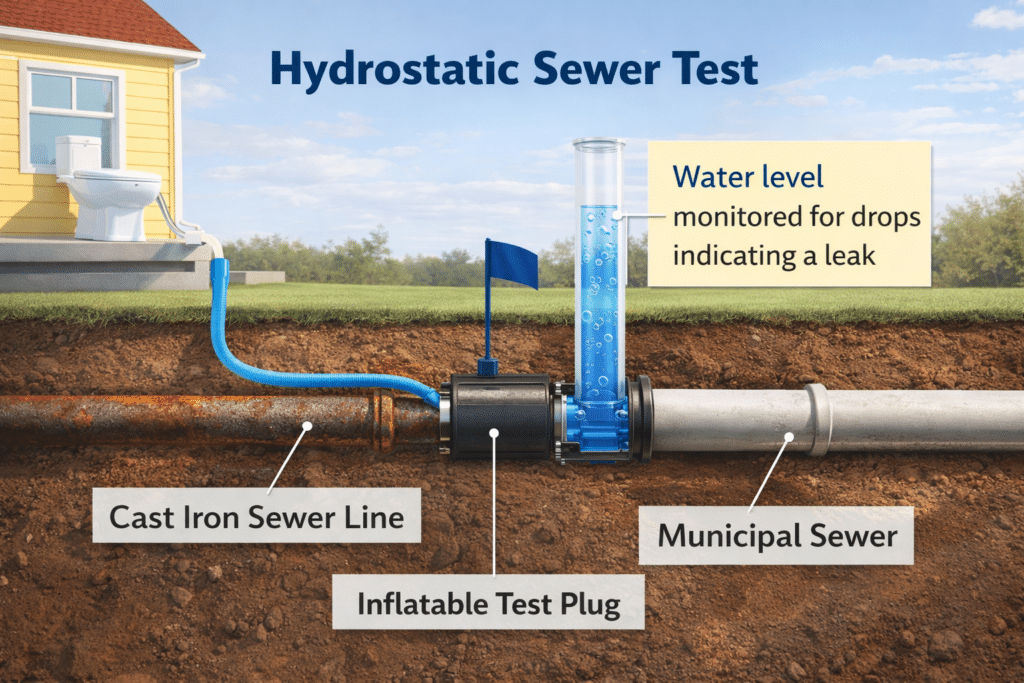
A hydrostatic test is a leak check for the sewer and drain lines running under your concrete slab. Our technician seals your main sewer line with an inflatable test ball at the cleanout, fills the under-slab drain system with water to slab level, and monitors the water level for 15 to 20 minutes. If the level holds steady, your lines are sealed. If it drops, water is escaping somewhere beneath your foundation, and we move to locating it.
The test uses plain water at normal, everyday pressure. There is no pressurization, no cutting, no digging, and you do not need to leave your home. It is the only reliable way to answer the question a standard home inspection cannot: does this house leak under the slab?
Why it matters here more than most places: Houston’s expansive clay soil swells and shrinks with every wet-dry cycle, and that constant movement works on the rigid pipes under your slab year after year. Homes built before roughly 1975 almost universally have cast iron drain lines, which corrode from the inside out over 50 to 75 years, and cast iron stayed in use into the mid-1980s.
If your home is from that era and has never been tested, there is a real chance it is leaking right now and you would have no way to know. Learn more about how hidden sewer leaks affect residential foundations from the Foundation Performance Association, a Houston-based organization dedicated to foundation education for homeowners.
Signs You Need Hydrostatic Testing in Houston
Houston’s clay soil shifts constantly with seasonal moisture changes, and that movement stresses the pipes buried beneath your slab until they crack, corrode, or separate at the joints. The damage happens where you cannot see it, but your home usually gives off warnings:
- You smell sewage inside the house but cannot find a source
- Soft spots, cracks, or shifting in your flooring
- Wet patches or an unusually green strip of grass in the yard
- Slow drains throughout the entire home, not just one fixture
- Unexplained increases in your water bill
- Foundation cracks, sticking doors, or a musty smell that cleaning does not fix
- Your home was built before 1985 and still has its original cast iron drain lines
- You are buying or selling a home in the Houston area
- A foundation repair company has asked for a plumbing test
Any one of these justifies a test. Several together make it urgent. The sooner you test, the less time a hidden leak has to erode the soil supporting your foundation.
Buyers, sellers, and realtors: review our hydrostatic sewer test guide before the option period ends.
How Our Hydrostatic Testing Process Works
Access the Cleanout
We locate your main sewer cleanout, the capped access pipe near your foundation or in the yard. If it is buried or was never installed, we quote the excavation or installation upfront before proceeding.
Insert and Inflate the Test Ball
An inflatable rubber test ball goes into the main line at the point where your plumbing exits the slab toward the city connection, sealing off the under-slab system completely.
Fill the System with Water
We fill the isolated lines with water to the level of the lowest drain in your home, charging the entire under-slab system at normal static pressure.
Monitor the Water Level
For 15 to 20 minutes we watch the level. Steady means your lines are intact. Dropping confirms a leak beneath the slab.
Isolation Testing When the Test Fails
On a failed test, we can isolate individual branch lines and test each section separately, narrowing the leak to a specific run of pipe. On larger homes with multiple bathrooms, this is what turns "there is a leak somewhere" into "the leak is in the line serving the hall bath." Precise location matters, because under-slab access is priced by the foot and you want to open exactly the right spot.
Camera Inspection and Results
A sewer camera run, usually on the same visit, confirms the exact location and shows the condition of the pipe: the material, corrosion level, root intrusion, and any bellies holding water. You get the results, the report, and the drain line map explained on site.
What Happens If We Find a Leak?
A failed test means water is escaping beneath your slab. It does not automatically mean a full sewer replacement. The right repair depends on what the camera and isolation testing show, and we handle the entire path in-house so you never need a second company.
One honesty note we stand behind: on badly corroded cast iron, spot repairs sometimes chase the pipe, because the “good” section a patch would tie into is failing too. If patching your system would be throwing money away, we will say so and show you why on camera.
After any repair, we retest. The job is not done until a second hydrostatic test proves the system holds water, and you get that passing report for your records.
Sewer Camera inspection
Every repair recommendation starts here: exact location, pipe material, and condition on video. A camera run is usually completed on the same visit as your test.
Spot Repair
Damage limited to one section gets a targeted repair. We open only the area needed and leave the rest of the system untouched. Learn more on our sewer line repair page.
Trenchless
Pipe Lining
(CIPP)
A resin liner hardens inside the damaged pipe, creating a new inner surface with no excavation. Yard and flooring stay intact. Learn more on our trenchless sewer replacement page.
Full Sewer Line Replacement
Hydrostatic Testing for Houston Home Buyers and Sellers
Standard home inspections do not include under-slab sewer testing. Texas inspection standards do not require it, which means buyers regularly close on homes with hidden slab leaks and discover the problem only after they move in, when the cost falls entirely on them. A pre-purchase hydrostatic test changes that.
The paperwork, in plain English. Texas has a dedicated form for this: the TREC Addendum for Authorizing Hydrostatic Testing (Form 48-1). Paragraph 7A of the standard residential contract requires the seller’s written consent before testing, and the addendum is that consent. It states the buyer pays for the test, and it lets the parties choose who is liable if the test causes damage. Worth knowing on both sides: the test uses normal water levels and does not stress sound plumbing. Pipes that “fail during the test” were already failing.
For buyers: A test during the option period turns an unknown into a number. If a leak is found, our camera inspection, drain line map, and written repair quote give you concrete negotiating material: price reduction, closing credit, or seller-completed repair. If the test is clean, you close knowing the system under the slab is sound.
For sellers: A dated passing report from a licensed plumber removes the single most common objection on older Houston homes before buyers raise it. And if a pre-listing test fails, you found out privately, with time to repair on your terms instead of negotiating against a deadline.
For realtors: We schedule around option periods, deliver written reports and drain maps your clients can act on, and answer the addendum questions your clients will ask. Call (832) 662-4288 to set up testing for your next transaction.
Full guide: what a hydrostatic sewer test means for Houston buyers, sellers, and realtors.

How Much Does a Hydrostatic Test Cost in Houston?
A hydrostatic test in Houston costs a few hundred dollars. An undetected under-slab leak costs foundation repairs, water damage, and emergency sewer replacement. Here is our pricing:
| Service | Price |
|---|---|
| Hydrostatic test (standard single-story home, accessible cleanout) | $250 - $400 |
| Hydrostatic test + same-visit sewer camera inspection | $450 - $800 |
| Complete under-slab diagnostic package: hydrostatic test, isolation testing if needed, full camera inspection, water supply pressure test, and shower pan test where applicable | Quoted upfront |
| Cleanout excavation or installation (if yours is buried or missing) | Quoted upfront |
Every price is quoted before we start. No trip charge, no hidden fees, and no surprise line items after the test is complete. Larger homes, multiple sewer branches, and difficult cleanout access can affect the price; we will tell you exactly how before anything is scheduled.
For a full breakdown of what drives hydrostatic test pricing in Houston, including who pays during a home sale and when insurance covers the test, read our 2026 hydrostatic test cost guide.
Ready to Get Your Price?
Repipe Solutions Inc. provides transparent, upfront pricing before we begin any work. No hidden fees and no surprise charges after the test is complete.
Why Houston Homeowners Choose Repipe Solutions Inc.
Serving Houston since 2021 and trusted by thousands of homeowners, with 100+ five-star Google reviews. Every test is performed by a licensed plumber, never a helper working alone. When it comes to hydrostatic testing in Houston, you need a team that gives you accurate results and honest answers, and here is what that looks like in practice:
- Written report and drain line map with every test, not a verbal thumbs-up
- Same-visit camera inspection when the test fails, so you are not scheduling a second appointment to learn what you already paid to find out
- Independent testing for real estate deals and foundation repair projects: we do not sell foundation repair, so our test results carry no agenda
- Diagnosis through repair under one roof: spot repair, trenchless, and full replacement, with a retest to prove the fix
- Upfront pricing, no trip charge, 24 months 0% financing on qualifying repairs
Fully Trained
& Equipped
Prompt
Service
Written Report
Included
Quality
Materials
Licensed
& Insured
Competitive
Pricing
What Our Customers Say About Repipe Solutions Inc.
"We'd spent months trying to find someone to repair a broken drain pipe underneath our slab. Other plumbers either weren't interested, wouldn't respond, or gave us exorbitant pricing. Matt bid the job, fairly, and had the excavation, repair, and back-filling done in a single day. A project that had been hanging over our heads for months got taken care of with one phone call to Matt. I highly recommend Repipe Solutions!"
Clay Hestilow
Google Review
"I hired Repipe Solutions to run a drain camera at one of my properties. They found the issue and had the excavation and the drain pipe fixed within 24 hours. I would recommend this company to anyone. I'm happy and my tenants are happy. Job well done!"
Heather Mckenna
Google Review
Frequently Asked Questions
How long does a hydrostatic test take?
Does the hydrostatic test damage my pipes?
No. The test fills your existing sewer lines with water at normal pressure levels. It does not stress or damage pipes that are in good condition. The inflatable test ball is inserted and removed without any cutting or excavation.
Can I stay home during a hydrostatic test?
Yes. The hydrostatic test is completely non-invasive. You do not need to vacate the property. Our team works quickly and cleanly with minimal disruption to your home and your day.
Is a hydrostatic test the same as a sewer camera inspection?
No. They serve different purposes and work best together. A hydrostatic test tells you whether a leak exists beneath your slab. A sewer camera inspection shows you exactly where the damage is located and what condition the pipe is in. When a hydrostatic test comes back positive, a camera inspection is always the recommended next step.
What if my test comes back clean?
Do I need a hydrostatic test if I already had a sewer camera inspection?
Yes. A camera can miss hairline leaks; it shows the condition inside the pipe but cannot confirm water-tightness. The hydrostatic test proves whether the system holds water. They work best together: test first, camera second.
How much does a hydrostatic test cost in Houston?
What is isolation testing?
Who pays for the test when buying or selling a home?
Do I need a test before or after foundation repair?
Usually both, and your foundation contractor will likely require the post-repair test to activate their warranty. We perform the tests and provide independent written reports; we do not do foundation repair ourselves.
What happens if the test fails?
Camera inspection to locate the break, isolation testing if needed, a written quote with repair options from spot repair to trenchless lining to full replacement, and a retest after the work proving the fix. All in-house.